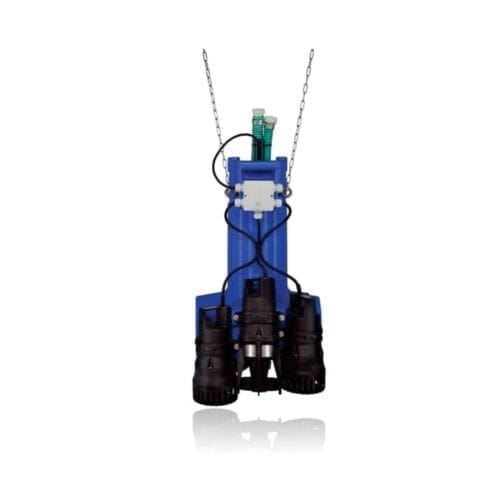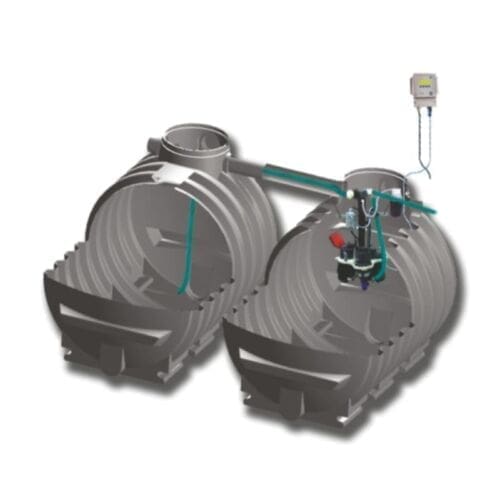


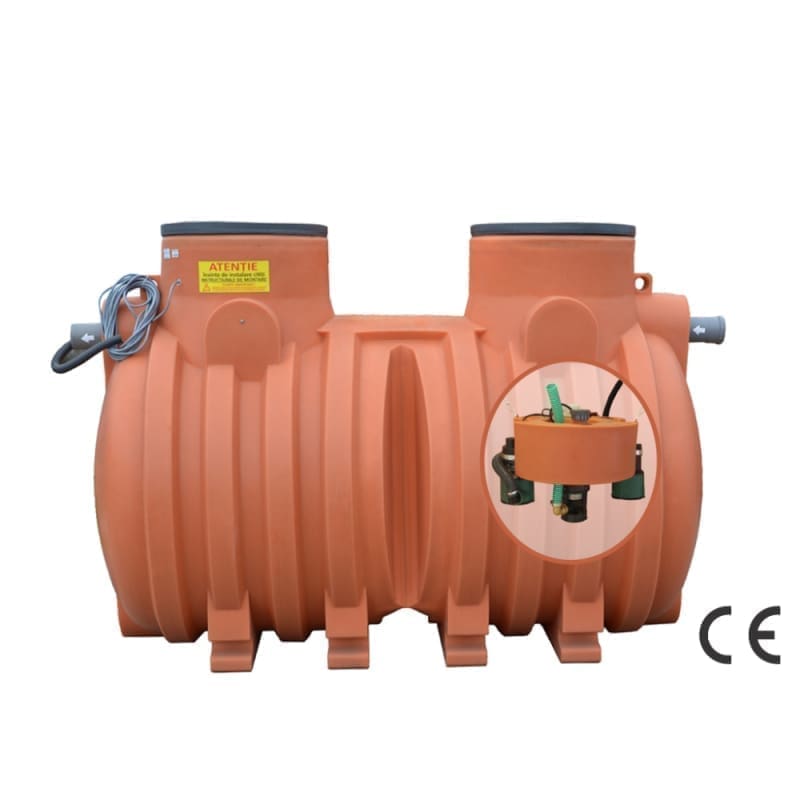
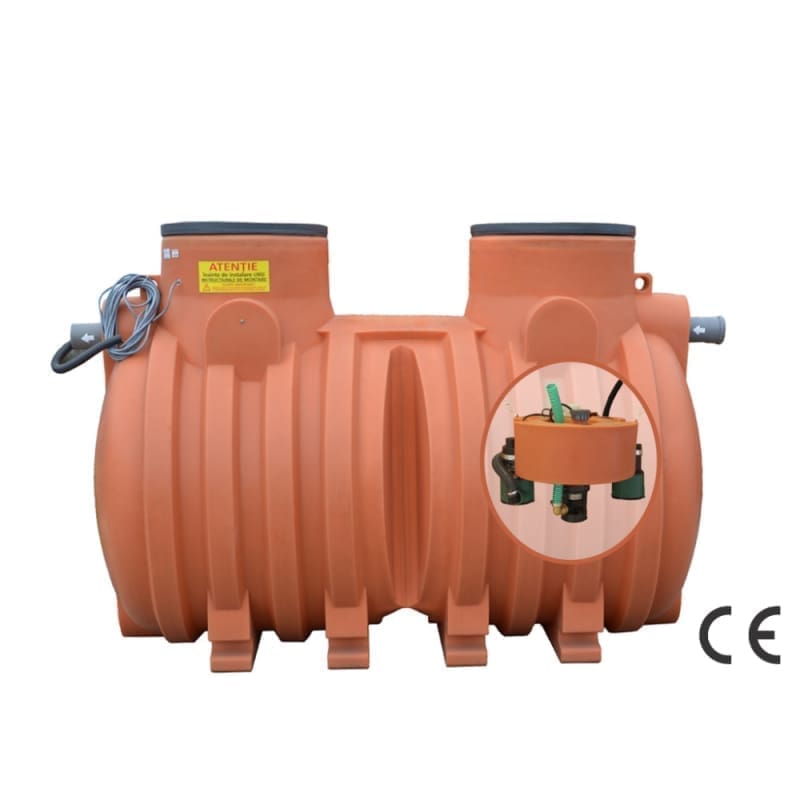
It treats domestic wastewater from residential buildings with a constant flow rate of up to 1000 L/day and a BOD₅ load of 0.3 kg/day. The plant is designed with a two-chamber polyethylene tank with a total volume of 3000 L, measuring 2650 x 1400 x 1760 mm, 192 kg – the first compartment functions as a buffer volume and for decantation, while the second compartment is used for wastewater treatment. In the second compartment, a pontoon-type polyethylene support is mounted, held by the tank walls via chains, on which the following are installed: – 1 aeration pump that ensures air bubbling and the dissolution of oxygen necessary for the microorganism population that decomposes organic substances into primary components, – 1 feed pump that transfers sludge from the treatment compartment to the first compartment and, through its body, ensures water transfer to the treatment compartment based on the principle of communicating vessels, – 1 treated water discharge pump. The minimum and maximum flotation heights of the pontoon with pumps are set to cover the calculated water flow. The entire process is controlled and monitored by a microprocessor, mounted in a control panel. The panel features a display with process parameters, a cycle reset button, and an RS232 connector for PC or programming console connection. The display shows the current phase and equipment status. Self-diagnosis functions for equipment status and automatic recovery from operating errors are implemented. Installed power 300 W, Energy consumption – depending on load 500 – 2000 W/day. The treatment plant operates on the SBR (sequencing batch reactor) principle, using a combination of activated sludge treatment and physical separation by decantation. This is achieved in 4 operating cycles/24 hours, each in 4 stages: 1 – Feeding – Domestic wastewater is transferred from the first compartment based on the principle of communicating vessels. 2 – Treatment – Upon feeding, the aeration pump starts operating. Thus, the air necessary for biological purification is introduced into the wastewater. Thanks to the pontoon system, water homogenization is also ensured. Aeration stages are alternated with pauses to ensure optimal nitrification-denitrification. 3 – Sedimentation – Aeration is stopped, allowing solid suspensions to settle at the bottom of the tank. Only clarified water remains in the upper zone. 4 – Discharge – The clarified water is discharged from the plant with the discharge pump. After the discharge operation is completed, the feed pump will transfer sludge from the treatment compartment to the first compartment, after which the treatment cycle resumes. Vacation mode: If no water input from the first compartment is detected during the feeding stage, the plant enters vacation mode. Aeration occurs in shorter and more frequent cycles to keep bacteria alive. No water is discharged from the system. The plant automatically switches to normal operating mode as soon as water input from the first compartment is detected. ATTENTION! The plant can only treat domestic wastewater. Water accumulated in the plant must not contain chemicals that could harm the bacterial population. The plant must not be fed with: industrial wastewater, rainwater or recirculated pool water, water containing aggressive chemical agents, petroleum residues, oils, etc. aquaClean treatment plants comply with the performance requirements of EN 12566-3:2005/A1:2009.
VALCLEANIO SBR 1/6 LE WASTEWATER TREATMENT PLANT Q=1 m³/day
Download Wastewater Treatment System catalog
It treats domestic wastewater from residential buildings with a constant flow rate of up to 1000 L/day and a BOD₅ load of 0.3 kg/day. The plant is designed with a two-chamber polyethylene tank with a total volume of 3000 L, measuring 2650 x 1400 x 1760 mm, 192 kg – the first compartment functions as a buffer volume and for decantation, while the second compartment is used for wastewater treatment. In the second compartment, a pontoon-type polyethylene support is mounted, held by the tank walls via chains, on which the following are installed: - 1 aeration pump that ensures air bubbling and the dissolution of oxygen necessary for the microorganism population that decomposes organic substances into primary components, - 1 feed pump that transfers sludge from the treatment compartment to the first compartment and, through its body, ensures water transfer to the treatment compartment based on the principle of communicating vessels, - 1 treated water discharge pump. The minimum and maximum flotation heights of the pontoon with pumps are set to cover the calculated water flow. The entire process is controlled and monitored by a microprocessor, mounted in a control panel. The panel features a display with process parameters, a cycle reset button, and an RS232 connector for PC or programming console connection. The display shows the current phase and equipment status. Self-diagnosis functions for equipment status and automatic recovery from operating errors are implemented. Installed power 300 W, Energy consumption - depending on load 500 - 2000 W/day. The treatment plant operates on the SBR (sequencing batch reactor) principle, using a combination of activated sludge treatment and physical separation by decantation. This is achieved in 4 operating cycles/24 hours, each in 4 stages: 1 - Feeding - Domestic wastewater is transferred from the first compartment based on the principle of communicating vessels. 2 - Treatment - Upon feeding, the aeration pump starts operating. Thus, the air necessary for biological purification is introduced into the wastewater. Thanks to the pontoon system, water homogenization is also ensured. Aeration stages are alternated with pauses to ensure optimal nitrification-denitrification. 3 - Sedimentation - Aeration is stopped, allowing solid suspensions to settle at the bottom of the tank. Only clarified water remains in the upper zone. 4 - Discharge - The clarified water is discharged from the plant with the discharge pump. After the discharge operation is completed, the feed pump will transfer sludge from the treatment compartment to the first compartment, after which the treatment cycle resumes. Vacation mode: If no water input from the first compartment is detected during the feeding stage, the plant enters vacation mode. Aeration occurs in shorter and more frequent cycles to keep bacteria alive. No water is discharged from the system. The plant automatically switches to normal operating mode as soon as water input from the first compartment is detected. ATTENTION! The plant can only treat domestic wastewater. Water accumulated in the plant must not contain chemicals that could harm the bacterial population. The plant must not be fed with: industrial wastewater, rainwater or recirculated pool water, water containing aggressive chemical agents, petroleum residues, oils, etc. aquaClean treatment plants comply with the performance requirements of EN 12566-3:2005/A1:2009.
It treats domestic wastewater from residential buildings with a constant flow rate of up to 1000 L/day and a BOD₅ load of 0.3 kg/day. The plant is designed with a two-chamber polyethylene tank with a total volume of 3000 L, measuring 2650 x 1400 x 1760 mm, 192 kg – the first compartment functions as a buffer volume and for decantation, while the second compartment is used for wastewater treatment. In the second compartment, a pontoon-type polyethylene support is mounted, held by the tank walls via chains, on which the following are installed: - 1 aeration pump that ensures air bubbling and the dissolution of oxygen necessary for the microorganism population that decomposes organic substances into primary components, - 1 feed pump that transfers sludge from the treatment compartment to the first compartment and, through its body, ensures water transfer to the treatment compartment based on the principle of communicating vessels, - 1 treated water discharge pump. The minimum and maximum flotation heights of the pontoon with pumps are set to cover the calculated water flow. The entire process is controlled and monitored by a microprocessor, mounted in a control panel. The panel features a display with process parameters, a cycle reset button, and an RS232 connector for PC or programming console connection. The display shows the current phase and equipment status. Self-diagnosis functions for equipment status and automatic recovery from operating errors are implemented. Installed power 300 W, Energy consumption - depending on load 500 - 2000 W/day. The treatment plant operates on the SBR (sequencing batch reactor) principle, using a combination of activated sludge treatment and physical separation by decantation. This is achieved in 4 operating cycles/24 hours, each in 4 stages: 1 - Feeding - Domestic wastewater is transferred from the first compartment based on the principle of communicating vessels. 2 - Treatment - Upon feeding, the aeration pump starts operating. Thus, the air necessary for biological purification is introduced into the wastewater. Thanks to the pontoon system, water homogenization is also ensured. Aeration stages are alternated with pauses to ensure optimal nitrification-denitrification. 3 - Sedimentation - Aeration is stopped, allowing solid suspensions to settle at the bottom of the tank. Only clarified water remains in the upper zone. 4 - Discharge - The clarified water is discharged from the plant with the discharge pump. After the discharge operation is completed, the feed pump will transfer sludge from the treatment compartment to the first compartment, after which the treatment cycle resumes. Vacation mode: If no water input from the first compartment is detected during the feeding stage, the plant enters vacation mode. Aeration occurs in shorter and more frequent cycles to keep bacteria alive. No water is discharged from the system. The plant automatically switches to normal operating mode as soon as water input from the first compartment is detected. ATTENTION! The plant can only treat domestic wastewater. Water accumulated in the plant must not contain chemicals that could harm the bacterial population. The plant must not be fed with: industrial wastewater, rainwater or recirculated pool water, water containing aggressive chemical agents, petroleum residues, oils, etc. aquaClean treatment plants comply with the performance requirements of EN 12566-3:2005/A1:2009.
| UM colete | PIECE |
|---|---|
| Ambalare | NEAMBALAT |
| Echipament cu PIF | FROM |
| Tip articol | WASTEWATER TREATMENT PLANT |
| Garantie 2 | 0 Months |
| Cod CPV | CPV 42996000-4 |
| Cantitate colet | 1 |
| Deseuri Electronice | 4.7 |
| Perioada garantie | 24 Months |
| Cod vamal | 84212100 |
| Subclasa | TREATMENT PLANTS/UNITS UNDER 50 LE |